Today, a ring around the sun had people talking.
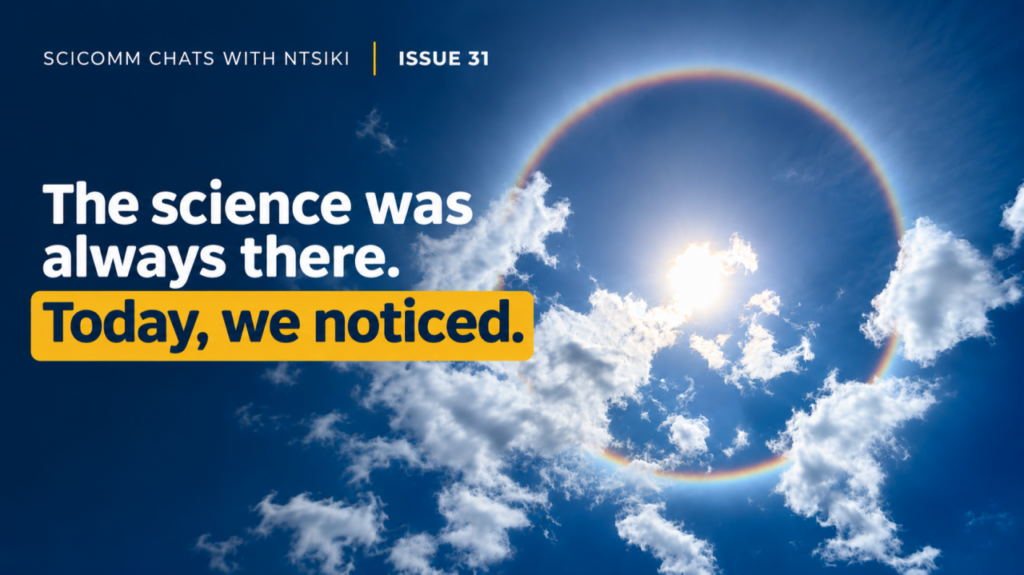
Across parts of South Africa, including Johannesburg and Pretoria, people spotted a bright circle of light surrounding the sun. Photographs made their way onto social media, accompanied by questions about what people were seeing. It was beautiful, but it was also unfamiliar. What was it? What caused it? Why was it happening?
For me, those questions are where this conversation about science communication begins.
People were not necessarily looking for a science lesson. Something had caught their attention, and they wanted to understand it. In that moment, science wasn’t an abstract subject or something happening somewhere far away. It was connected to an experience they were having.
The curiosity was already there. The opportunity was to respond.
Start with what people are seeing
The ring is called a solar halo. In this case, it was identified as a 22-degree halo, an optical phenomenon caused by sunlight passing through tiny, six-sided ice crystals in high-altitude clouds. The crystals bend the light, producing the ring we see around the sun. The “22 degrees” describes the apparent distance from the sun to the ring, measured as an angle—not the temperature.
That explanation can become technical quite quickly. We can talk about refraction, hexagonal crystals, cirrus clouds and angular distance. Each term has a place. But where we start matters.
Imagine someone asking, “What is that ring around the sun?” and receiving an explanation full of terms they need explained before they can understand the answer.
An accurate answer is necessary. It is not always sufficient.
A more accessible starting point might be:
“There are tiny ice crystals in thin clouds high above us. As sunlight passes through them, it bends. The shape of those crystals and the way they redirect the light produce the ring we can see.”
Then, if the person wants to know more, we can build on that. We can introduce “refraction” as the name for that bending of light. We can explain why there can be ice high above us even when it feels warm on the ground. We can explore why the light forms a circle.
We do not have to squeeze everything we know into the first answer.
This is the work of science communication
A scientist studying light or the atmosphere can explain the processes behind a solar halo. The communication task is to make that explanation useful to the person asking.
Those roles can overlap. Scientists can be excellent science communicators. The point is not to separate the people who understand the science from the people who explain it. It is to recognise that explaining something well requires attention to more than the subject itself.
What has the person noticed? What are they actually asking? Which words will help them understand, and which ones need unpacking? How much detail is useful at this point?
For me, that is what it means to make science accessible. Not to strip away its meaning or assume people cannot understand complexity, but to give them a clear way in.
There is also a difference between naming something and explaining it. “It is a 22-degree halo” gives someone a label. Explaining how sunlight and ice crystals create the ring helps that label mean something.
And the explanation should respond to the whole situation. In this case, that includes a practical caution: a halo is not a reason to look directly at the sun, which can damage your eyes.
Science does not have to be spectacular to be worth explaining
A ring around the sun is a striking starting point. It is unusual enough to interrupt an ordinary day and make people ask questions.
But I do not want us to reserve this kind of curiosity—or our communication efforts—for the spectacular.
Think about the questions we could start with in everyday life: Why does bread rise? Why does a mirror fog up after a shower? How does a phone know where we are? What does the information on a food label actually tell us?
These are possible openings for a science conversation, not because we think everyone needs a lecture, but because they start with something familiar.
That is the approach I want us to consider as communicators: start with the experience, listen for the question, and build the explanation from there.
Rather than beginning with, “How do I get people interested in my field?”, we might begin with, “Where does my field meet something people already notice, use or care about?”
The answer will not always be a beautiful ring in the sky. Sometimes it will be a household frustration, a decision someone needs to make, or something they have wondered about for years without knowing whom to ask.
An explanation does not take away the beauty
Knowing that tiny ice crystals bend sunlight does not make the halo less beautiful. It gives us another way to appreciate what we saw: a visible effect created by something far too small and distant for us to see individually.
That is the kind of science communication I want to keep making space for. Communication that takes people’s questions seriously, explains without talking down to them, and leaves room for both understanding and wonder.
Today, the ring around the sun gave us an opening.
The science was already there. Our work is to help people make sense of it.