Your paper is published. You have shared the link on LinkedIn, sent it to your collaborators and added it to your list of publications. For everyone involved, that is a milestone worth celebrating.
But what happens next?
Somewhere, a district health manager is deciding where to allocate resources. A policymaker is reviewing a programme. A farmers’ co-operative is weighing up a change in practice. Your findings could help with that decision. Have they reached the people making it?
At the Evidence to Action conference in Accra in June, the Speaker of The Gambia’s National Assembly, Fabakary Tombong Jatta, described Africa as “data-rich but information-poor”. He warned that research findings often “gather dust” while decisions are taken without adequate evidence. It is a useful distinction: producing evidence and putting it to work are not the same task.
This is where I want to take this week’s Scicomm Chats conversation. We talk a lot about making research accessible. We also need to talk about who takes responsibility for getting it to the people who could use it.
Where does the responsibility sit?
It is easy to see how this becomes somebody else’s job.
A researcher might expect the communications office to handle dissemination. The communications team might only hear about the study when the paper is ready for publicity. The funding proposal might include a dissemination plan, but who has the time, budget and responsibility to carry it through once the research is complete?
These are not necessarily people refusing to do their jobs. Sometimes, the work between publication and use has never been clearly assigned.
And “we shared the findings” does not quite answer the question. Shared with whom? In what form? At what point in their decision-making? Did they have an opportunity to ask questions or explain why the recommendation would be difficult to implement?
Having a paper available is not the same as having what you need to use it.
Start with the decision, not the study
For the researcher wondering what to do differently, I would start with one person and one decision.
Who needs this finding, and what are they trying to decide?
That gives you a more useful starting point than trying to summarise the whole paper. Instead of opening with the study background, you can explain the problem your finding helps them understand, what the evidence suggests and what they could consider doing next.
The methods still matter. So do the limitations. You are not removing those or making the finding sound more certain than it is. You are changing the order so that your reader can first understand why the research is relevant to their work.
Try these questions with one finding from your latest study:
– Who could use this?
– What decision could it inform?
– What do they need to understand about the finding, including its limitations?
– What would be a reasonable next step?
If you cannot answer those questions yet, that is a good reason to speak to the intended user before writing another summary.
Clearer writing will not resolve every barrier to research use. But it gives you a practical place to begin, while helping you identify what else is needed.
Someone has to own the next step
The bigger question is how we plan for this work.
I would like to see the responsibility agreed before publication, while there is still time to make introductions, understand what intended users need and budget for the work involved. That does not mean the researcher must do everything. It means being clear about who will do what.
Who will speak to the relevant organisation? Who will prepare material for that audience? Who will follow up? And who will keep the conversation going if the findings raise questions that a summary cannot answer?
In a small team, several of those tasks may fall to the researcher. In a larger project, they may be shared across researchers, communications staff and partner organisations. Either way, “dissemination” needs to become a set of responsibilities rather than a line in a proposal.
Taking the conversation to Science Forum South Africa
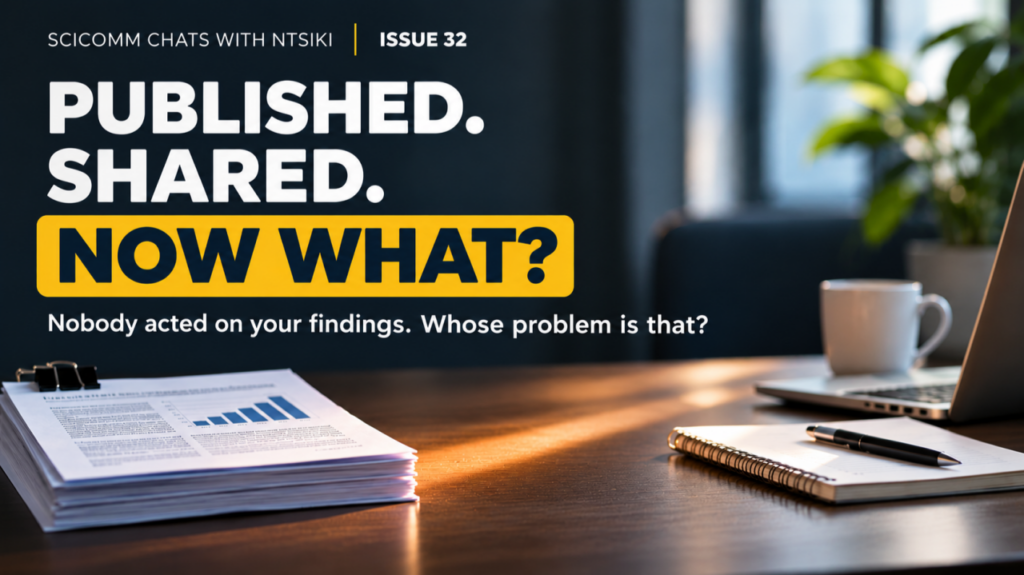
Next week, I will be moderating a session at Science Forum South Africa called “Nobody Acted On Your Findings. Whose Problem Is That?”
Joining me will be science journalist and editor Ms Linda Nordling , Dr Zimbili Bonisiwe Sibiya of AUDA-NEPAD SANWATCE at Stellenbosch University, Dr Mbulelo Ncango of the The National Research Foundation of South Africa (NRF), Dr Natisha Dukhi of the HSRC (Human Sciences Research Council), and Ms Jansie Niehaus of the National Science and Technology Forum (NSTF).
The session takes place on Wednesday 2 December from 11:20 to 12:50, in the Onyx room at the Council for Scientific and Industrial Research (CSIR) International Convention Centre in Pretoria. We want to examine what happens between producing research and using it, where responsibility sits, and what researchers, institutions, communicators and funders could do differently. There will also be space for examples and contributions from the room.
Siakhula will be at the forum throughout, with our Translation Desk. Bring one research finding, and we will spend five minutes working through how to explain it to the person who needs to act on it.
Join us at Science Forum South Africa
Come along to the panel, visit the Siakhula Translation Desk and take part in the conversations about how research can inform decisions.
Science Forum South Africa takes place at the CSIR International Convention Centre in Pretoria, with the main forum sessions running from 2–4 December 2026. Register to attend using the link shared by the Department of Science, Technology and Innovation: https://www.sfsa.co.za/registration/.